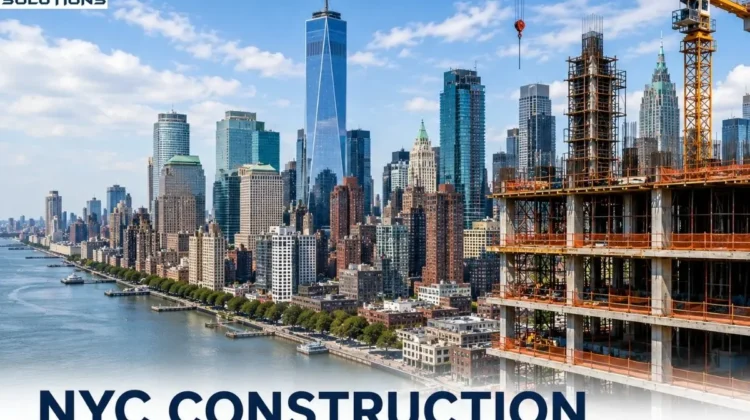
Complete NYC Construction Costs Analysis 2026
NYC construction costs in 2026 are shaped by four compounding pressures: prevailing wage mandates, borough-specific site logistics, material price volatility, and a tightening skilled labor market. This analysis breaks down what each project type actually costs — trade by trade, borough by borough.
Construction cost estimating in NYC is not a single number. It shifts based on your project type, your borough, your finish level, and whether you are working under union or open-shop labor agreements. Every one of those variables moves the number significantly.
This guide covers the full cost picture—residential, commercial, and industrial—with a clear breakdown of what drives each category. If you are a general contractor, subcontractor, or developer working in New York, this is the analysis you need before a single drawing is submitted.
NYC Construction Cost Per Square Foot in 2026
Construction cost per square foot in NYC varies widely based on project class, finish specification, and structural system. According to Turner & Townsend’s 2026 global benchmark, NYC now averages $534 per square foot — the highest of any city in the world. Residential, commercial, and luxury builds each carry distinct labor and material profiles that produce very different per-square-foot outcomes.
Residential Construction Costs Per Square Foot
Standard residential construction in NYC runs from $200 to $500 per square foot for single-family and low-rise multi-family projects. Prevailing wage requirements, local union rates, and high material freight costs all push the baseline upward before a single wall is framed.
Custom residential builds with architectural complexity—cantilevers, custom millwork, and high-end MEP specifications—reach $500 to $800 per square foot. Luxury homes in Manhattan and premium Brooklyn submarkets push past $1,000 per square foot when premium finishes multiply against an already elevated labor base.
Over the past three years, NYC residential construction costs have risen faster than national averages. Material prices for structural steel and concrete have stabilized slightly in 2026, but labor cost inflation is running at 5.2% year-over-year and has not reversed.
Commercial Construction Costs Per Square Foot
Commercial construction in NYC ranges from $430 to $1,000 per square foot for office space depending on class and height. Core-and-shell work prices differently from full fit-out. The cost spread within commercial is wider than residential because the project types are more structurally diverse.
Office construction, retail buildouts, and hospitality projects each have distinct cost drivers. A shell-and-core office floor carries different requirements from a full restaurant build—the restaurant includes commercial kitchen infrastructure, grease traps, and ventilation systems that a standard office floor does not.
BidWin Solutions has completed over 500 commercial estimates across NYC and surrounding markets, giving its estimators a verified benchmark database for commercial cost per square foot by project type—not generic averages, but trade-level data from real projects.
Luxury and High-End Construction Costs
Luxury construction in Manhattan and select Brooklyn submarkets sits at the top of the cost spectrum—regularly exceeding $1,000 per square foot for residential towers with custom stonework, imported material specifications, architectural glass systems, and high-density MEP packages.
The combination of union labor, tight site logistics, high-rise structural systems, and premium finish packages creates a cost profile that requires experienced estimation to price accurately. This is where estimating errors are most expensive and most common.
Construction Costs by Project Type in NYC
Each project type in NYC carries a different cost structure driven by its structural system, MEP requirements, finish specification, and site access constraints. Understanding cost by project type is more precise — and more useful — than relying on a single citywide average that obscures the real variation.
| Project Type | Primary Cost Driver | Key Trade |
|---|---|---|
| Single-Family Home | Custom finishes, MEP density | Lumber, Drywall, MEP |
| Multi-Family Building | Structural system, unit count | Concrete, Steel, Electrical |
| Office Space (Class A) | MEP coordination, curtain wall | Electrical, Mechanical, Drywall |
| Retail Build-Out | Storefront systems, flooring | Painting, Flooring, Sitework |
| Hotel / Hospitality | FF&E, plumbing density | Plumbing, MEP, Finishes |
| Warehouse / Industrial | Slab specification, loading docks | Concrete, Sitework, Electrical |
Multi-Family Building Construction Costs NYC
Multi-family construction in NYC—whether three-family brownstones or 200-unit apartment towers—is governed by a complex intersection of zoning requirements, building code specifications, and financing cost structures that directly affect total project cost.
The structural system choice between concrete and structural steel has a major impact on budget. BidWin’s structural steel estimating team handles full fabrication and erection cost breakdowns, including connection details, shop drawing review coordination, and material price volatility adjustments based on current market rates.
Office Construction Cost Per Square Foot NYC
Office construction in NYC in 2026 remains active in Class A submarkets—Midtown, Hudson Yards, and the World Trade Center area—even as the office-to-residential conversion trend reshapes older stock. These projects demand detailed MEP coordination across all relevant CSI divisions.
BidWin’s ASPE-certified electrical estimators handle full commercial electrical scopes—conduit and wire, panels, switchgear, lighting, and low-voltage systems. Electricity typically represents 15 to 20 percent of total commercial construction cost, making accurate electrical takeoff a key determinant of bid competitiveness.
Warehouse and Industrial Construction Costs NYC
Industrial and warehouse construction in the outer boroughs — particularly Queens and the Bronx — requires site-specific cost analysis. Slab specifications, loading dock systems, and stormwater management drive significant cost variation between sites that look similar on paper.
BidWin’s sitework estimating team uses Kubla Cubed and Earthwork Pro for cut-and-fill calculations, mass-haul analysis, and grading quantity takeoffs—areas where an error in early estimation directly impacts profitability on every project that follows.
What Is Driving NYC Construction Costs in 2026
Three forces are driving construction costs in NYC higher in 2026: persistent skilled labor shortages, continued material cost pressure in specific categories, and compliance cost increases tied to Local Law 97 carbon emissions requirements. Understanding each one is necessary for building a budget that holds.
Material Costs in NYC Construction
Material costs in NYC run 30 to 40 percent above national averages. Steel rebar currently prices between $1,300 and $2,000 per ton for commercial-grade orders. Canadian lumber tariffs (14.5% duty in 2026) keep lumber prices volatile quarter to quarter. Basic construction materials run roughly $50 to $75 per square foot before NYC logistics premiums.
BidWin confirms material prices directly with local yards and cross-references against RSMeans — the gold standard construction cost database — to ensure every estimate reflects current market pricing, not six-month-old database averages. This process is applied across all 3,000+ completed projects in their database.
Prevailing Wage and Subcontractor Rates in NYC
Prevailing wage requirements apply to all publicly funded projects across the five boroughs. Skilled union trades earn $85 to $165 per hour in total compensation. The NYC Comptroller’s 2026 schedule sets supplemental benefit rates at $27.49/hour effective January 2026, on top of trade-specific base wages that vary significantly by discipline.
BidWin uses the client’s own labor rates — not generic database averages — when calculating labor cost. This produces estimates that reflect the contractor’s real cost structure rather than a theoretical market rate, which is a direct reason BidWin’s estimates maintain an 80% bid win ratio.
Construction Inflation Trends in New York (2023–2026)
Construction cost inflation in NYC has moderated from the sharp spikes of 2021 to 2023 but has not reversed. The cumulative effect is that 2026 baseline costs are 25 to 40 percent higher than 2020 benchmarks across most trade categories. Current inflation is running at approximately 5.2 percent year-over-year.
Escalation clauses are now standard in NYC construction contracts. BidWin accounts for escalation risk in design-stage estimates by applying current market pricing with clearly stated validity periods—protecting both the developer and the GC from mid-project cost surprises.
NYC Construction Costs by Borough
Construction costs are not uniform across NYC’s five boroughs. Site access, local labor market density, subcontractor concentration, and project type mix all produce distinct cost profiles for Manhattan, Brooklyn, Queens, the Bronx, and Staten Island — with spreads of 30 to 40 percent between the most and least expensive boroughs.
Manhattan Construction Costs
Manhattan commands the highest construction costs of any borough. Tight site logistics — no laydown yards, street permit requirements, tower crane placement constraints — add cost that simply does not exist in suburban markets. Deliveries must be precisely scheduled, and overtime premiums are frequently required to meet DOB-mandated construction hours.
High-rise construction in Manhattan requires structural systems, MEP coordination, and phased construction sequencing that adds cost at every stage. BidWin has completed estimates for urban commercial projects in Manhattan including 174 Mott Street and in the Bronx at 1956 Jerome Avenue.
Brooklyn and Queens Construction Costs
Brooklyn and Queens represent the most active new construction markets in the five boroughs. Multi-family residential, mixed-use development, and industrial conversion projects are driving consistent estimating demand. Both boroughs run 15 to 25 percent below Manhattan but remain significantly above national averages.
Bronx and Staten Island Construction Costs
The Bronx sees significant multi-family residential development tied to affordable housing programs, which bring prevailing wage requirements that substantially affect labor cost. Staten Island typically carries slightly lower cost than other boroughs—but material freight costs and project logistics still price above most suburban New York markets.
Building Permits, Fees, and Compliance Costs in NYC
Permit fees, compliance costs, and regulatory requirements in NYC add a meaningful layer above pure construction cost. Contractors and developers who exclude these from early budget models consistently face overruns at the permit stage — a problem that a complete estimate prevents before it starts.
NYC Building Department Permit Fees and Timelines
NYC DOB permit fees are calculated at a $130 minimum plus $13 per $1,000 of construction cost over $5,000, under Local Law 128 (effective December 2025). Filing fees, plan examination fees, and trade-specific permits—electrical, plumbing, and sprinkler—each add to the total. Special inspection requirements for structural, concrete, and welding work add further compliance cost on larger projects.
Plan review queues at DOB remain long for complex projects—standard residential typically runs 4 to 8 weeks; complex commercial with plan review can run 3 to 9 months. Permit timeline risk must be budgeted as a carrying cost, not assumed away.
Local Law 97 Compliance Costs for New Construction
Local Law 97 is now fully enforced in 2026. Buildings over 25,000 square feet that exceed carbon emission limits face penalties of $268 per metric ton of CO2 equivalent, assessed annually. For new construction, this requires MEP system decisions—high-efficiency HVAC, all-electric systems, enhanced insulation—that carry upfront cost premiums above standard code minimums.
BidWin’s MEP estimating team can price the cost difference between standard code compliance and Local Law 97-optimized specifications on a project-by-project basis—a critical service for developers building anything over 25,000 square feet in any borough.
Hidden and Overlooked Costs in NYC Construction Budgets
The most common source of budget overruns in NYC construction is not the primary scope — it is the costs excluded from the initial estimate. Soft costs, site logistics, escalation exposure, and contingency gaps consistently catch contractors and developers off guard, often after commitments are already made.
Site Preparation and Logistics Costs
Site preparation in NYC — demolition, shoring, underpinning adjacent structures, environmental testing, and remediation — can represent a significant share of total project cost on urban infill sites. These costs are frequently underestimated or excluded from early budgets because they require site-specific investigation to price accurately.
BidWin’s demolition estimating covers selective interior demolition, full structural demolition, and site clearing — including equipment, hand demo and mechanical demo labor, and saw-cutting costs. Nothing is left as a lump sum allowance.
Interior Finishes and Fit-Out Costs
Interior finish costs vary enormously by specification level. Standard commercial tenant improvement finishes carry a very different cost from high-end hospitality or luxury residential fit-out. The gap is wide enough to change a project’s financial model entirely if budgeted at the wrong specification level.
Escalation Clauses and Material Price Locks
Escalation clauses are now standard in NYC construction contracts—and for good reason. Material prices can shift significantly between the estimate date and the procurement date. Estimates without escalation provisions give developers false cost certainty.
BidWin’s design-stage estimates include clearly stated pricing validity periods and escalation exposure notes. For clients on the dedicated estimator model — retaining BidWin’s estimating capacity at a fixed weekly or monthly arrangement that reduces estimating cost by up to 50% versus an in-house hire — ongoing cost monitoring keeps the budget current through design and procurement.
NYC Construction Cost Estimating: From Feasibility to Final Budget

Accurate construction cost estimating in NYC requires a structured, phased approach that matches estimate accuracy to design completeness. A feasibility estimate based on schematic drawings is a fundamentally different product from a bid-ready estimate built from 100% construction documents—and treating one as the other produces budget failures.
Preliminary Cost Estimate vs Detailed Cost Estimate
| Estimate Type | Design Stage | Accuracy Range | Primary Use |
|---|---|---|---|
| Conceptual / Order of Magnitude | Schematic / Pre-Design | Wide range | Feasibility decision |
| Design Development Estimate | Design Development | Narrower range | Budget setting, financing |
| Bid-Ready Estimate (GMP) | 100% CDs | Tight range | Competitive bidding |
| Dedicated Estimator Model | All stages | Continuously updated | High-volume contractors |
BidWin follows AACE estimate classification guidelines — meaning each estimate product is clearly categorized by its accuracy class, design input completeness, and intended use. Clients are never sold a conceptual estimate as a bid-ready product.
Outsource Construction Estimating: The Quantity Takeoff Advantage
Outsourcing construction estimating to BidWin gives contractors access to a dedicated estimator using PlanSwift and Bluebeam Revu—measuring directly from PDF drawing sets, recording every quantity, and logging measurements in a structured Excel format organized by CSI Division.
Over 7 years and 3,000+ completed projects, BidWin’s team has developed verified productivity benchmarks for NYC-specific project types that general cost databases do not capture—urban high-rise concrete pours, Manhattan site logistics, and underground utility work in congested rights-of-way.
Feasibility Study: Is Your NYC Project Financially Viable?
Developers commit to design fees, land carry costs, and financing costs before they know whether the construction cost supports the financial model. A credible early-stage cost estimate from experienced estimators prevents expensive design work on projects that do not pencil—one of the most common and costly mistakes in NYC development.
BidWin’s design estimate service works from partial drawings, floor plans, or even written project descriptions to produce order-of-magnitude cost projections that give developers and architects real cost data at the decision point.
How to Manage and Reduce Construction Costs in NYC
Cost management in NYC construction is an active discipline that begins in design and continues through procurement and execution. Decisions made at the design stage lock in a significant portion of total project cost before a single permit is filed — which is why estimating involvement at the earliest possible stage produces the greatest return.
Value Engineering During the Design Phase
Value engineering in NYC construction means making specific structural and material substitution decisions that reduce cost without compromising program, code compliance, or design intent. It is most effective when estimators are engaged during design development—not after CDs are complete and all structural decisions are locked.
BidWin’s design estimating service supports value engineering by providing trade-level cost feedback at schematic and design development stages. When an architect or developer understands the cost impact of a structural system choice or specification upgrade, they can make informed decisions before the design is locked—and before the expensive rework begins.
How to Vet and Choose a Contractor in NYC
Subcontractor selection in NYC is as much a cost management decision as it is a quality decision. A subcontractor whose bid is low because they missed scope items will produce change orders that exceed the original cost delta. Accurate takeoffs protect the GC from this outcome.
BidWin’s estimates give GCs a verified quantity basis for scope leveling—comparing sub-bids against a common takeoff ensures that apparent price differences reflect real cost differences, not scope gaps. This is one direct reason BidWin’s drywall estimates maintain a 90% bid win ratio in one of the most competitive trade categories in NYC.
NYC vs Other Markets: How Construction Costs Compare
NYC is officially the most expensive construction market in the world, according to Turner & Townsend’s 2026 global benchmark—averaging $534 per square foot across all building types, ahead of San Francisco at $512 and Los Angeles at $445. Understanding this premium against other markets helps developers and GCs make accurate budget comparisons.
NYC vs Upstate New York Construction Costs
Construction costs in upstate New York—Albany, Buffalo, Syracuse—are materially lower than NYC across every project type. The NYC five-borough market runs 30 to 40 percent above upstate Buffalo and Rochester, driven primarily by labor rates, site logistics, and the NYC Construction Code overlay (DOB requirements, special inspections, Local Law 97) that upstate jurisdictions do not carry.
BidWin serves all 50 states with location-adjusted pricing based on ZIP code. This means a developer comparing a NYC project against an upstate alternative gets apples-to-apples cost data — the same AACE-guided methodology applied to both markets.
Why NYC Construction Is the Most Expensive in the US
Five structural factors place NYC at the top of every national construction cost index: union labor density and prevailing wage mandates, high material freight and logistics cost, site access constraints requiring overtime and specialized equipment, the regulatory compliance burden across DOB, DEP, and FDNY, and high subcontractor demand creating limited competitive bid pools.
None of these factors are temporary. They reflect the structural cost reality of building in a dense, heavily regulated urban environment with organized labor representation. Accurate cost estimation in this market requires estimators who understand NYC specifically — not just national averages applied with a regional multiplier.
Frequently Asked Questions
These are the most-searched questions about NYC construction costs in 2026, based on Google’s People Also Ask data. Each answer reflects real estimating experience across more than 3,000 projects completed by BidWin Solutions since 2017.
How much does construction cost per square foot in NYC?
NYC averages $534 per square foot across all building types in 2026 — the highest of any city in the world. Residential runs $200 to $500 per square foot for standard construction, with luxury builds reaching $800 to $1,000 or more. Commercial offices average $430 to $1,000 per square foot depending on class and height.
Is NYC the most expensive city in the world to build in?
Yes, as of 2025-2026. Turner & Townsend’s global benchmark report ranks NYC first at $534/sq ft average—ahead of San Francisco ($512/sq ft) and Los Angeles ($445/sq ft). High union labor costs, site logistics premiums, and regulatory compliance all contribute to this ranking.
How much do union construction workers make in NYC?
Skilled union trades in NYC earn $85 to $165 per hour in total compensation, including base wages and supplemental benefits. The NYC Comptroller’s 2026 prevailing wage schedule sets supplemental benefit rates at $27.49/hour from January 2026. Annual earnings range from $77,700 to over $150,000 depending on trade and seniority.
How long does it take to get a building permit in NYC?
Standard residential permits typically take 4 to 8 weeks. Complex commercial projects requiring full plan review at DOB can take 3 to 9 months. Projects in historic districts or requiring special inspections run on the longer end. Permit timeline risk must be budgeted as a carrying cost—delays are the norm, not the exception.
What is the cheapest borough to build in NYC?
Staten Island and the Bronx generally carry lower construction costs than Manhattan, Brooklyn, and Queens due to less site constraint and lower subcontractor demand pressure. However, all five boroughs remain significantly above national construction cost averages, so ‘cheapest’ is relative to NYC standards—not a suburban or national benchmark.
Disclaimer: Market cost ranges referenced in this article are based on publicly available 2026 benchmark data from Turner & Townsend, RSMeans, and the NYC Comptroller’s prevailing wage schedule. BidWin Solutions‘ service pricing is separate and provided on a per-project quote basis—contact the team directly for a firm estimate on your specific project.